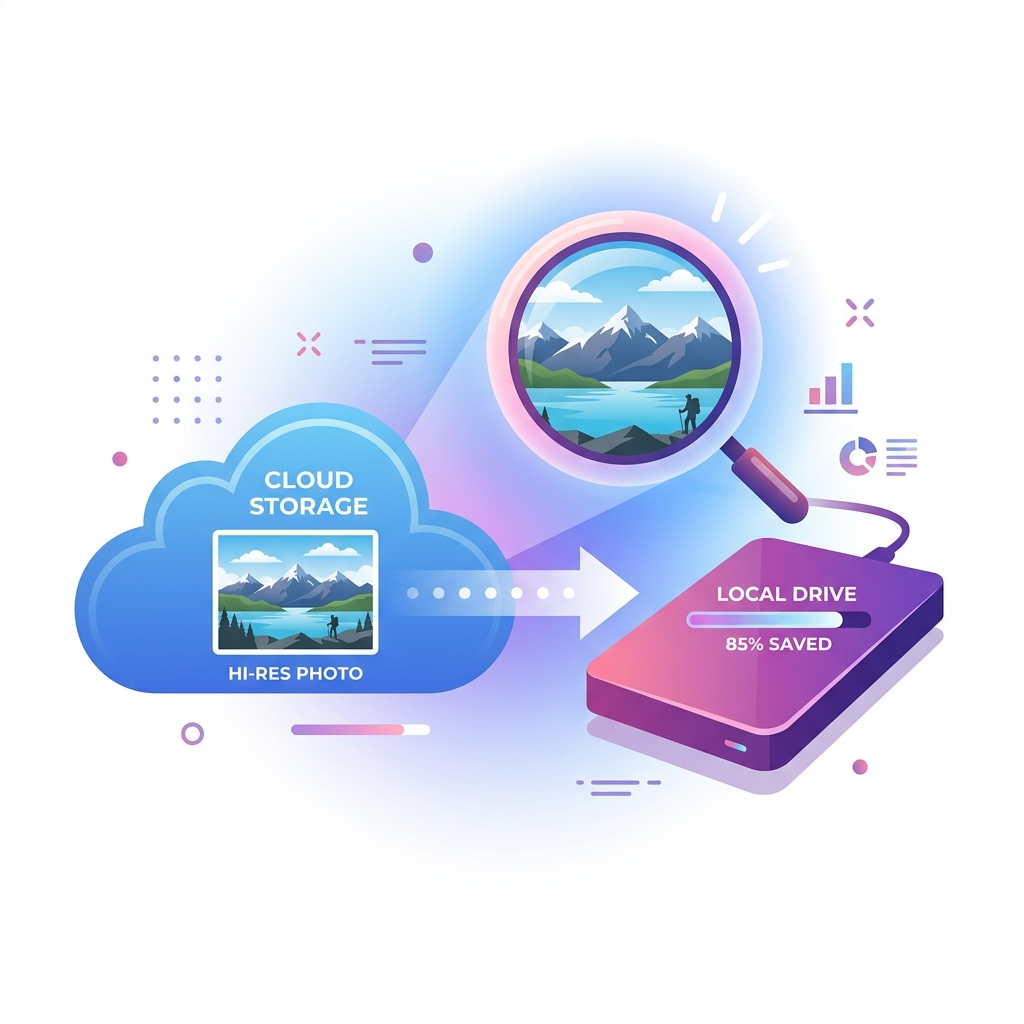
The Catastrophic Quality Loss of the 'Screenshot Method'
We live in a visually driven world. When you scroll past a stunning piece of interior design, a perfectly composed landscape photograph, or a brilliant piece of typography on Instagram, the immediate impulse is to capture it. For 90% of users, that means simultaneously squeezing the volume and power buttons to take a screenshot.
While a screenshot is instantaneous, it is the absolute worst possible method for preserving digital art. When you screenshot, you are not saving the photograph; you are taking a picture of your phone’s screen. This bakes the Instagram user interface, your battery icon, and the time into the image, requiring you to manually crop it later.
More critically, a screenshot captures the image at your phone screen's native resolution, completely ignoring the data-rich source file. Instagram has already compressed the image once upon upload. By screenshotting it, you are subjecting the image to a second, brutal layer of compression. This 'double-compression' destroys the micro-contrast, obliterates fine textures, and introduces ugly, blocky artifacts known as pixelation.
If your goal is to build a professional mood board, use the image as a reference in Adobe Illustrator, or display it on a 4K desktop monitor, a screenshot is entirely useless. You need the original, unadulterated source file.
Demystifying Instagram's Image Resolution Limits
To extract the best possible image, you must understand the ceiling of Instagram's technical capabilities. As of 2026, Instagram is not a platform for hosting raw, 40-megapixel DSLR files. The platform strictly regulates image dimensions to keep their server costs low and ensure fast loading times for mobile users.
The maximum width Instagram supports for any image is 1080 pixels. However, the height of the image dictates the overall resolution and file size. A standard square photo is 1080x1080 pixels. A landscape photo is typically 1080x566 pixels.
The absolute highest resolution achievable on Instagram is the 'Portrait' format, which utilizes an aspect ratio of 4:5. These images max out at 1080x1350 pixels. Therefore, if you are a photographer uploading work, always crop to 4:5 to utilize maximum screen real estate. If you are downloading work, know that a 1080x1350 JPEG is the absolute holy grail of Instagram extraction.
When you use a professional web parser like our Photo Downloader, the backend algorithm is specifically instructed to bypass the small, heavily compressed thumbnails that populate your mobile feed. Instead, it queries the backend Content Delivery Network (CDN) to locate the direct URL of that master 1080-pixel wide file, serving it to you untouched.
Advertisement
The Optimal Extraction Workflow for Creatives
Extracting the original file is a straightforward process, but establishing a clean, organized workflow separates the professionals from the amateurs. The process begins by acquiring the exact permalink of the post.
Navigate to the target photograph. It is imperative that you are viewing the specific post itself, not scrolling through a grid or a hashtag feed. Tap the 'Share' icon (the paper plane) and select 'Copy Link'. If you are on a desktop browser, you can simply highlight and copy the URL from the address bar at the top of your screen.
Proceed to the dedicated Photo Downloader utility. Paste your link into the primary input field. If the post you are targeting contains multiple images (a swipeable Carousel), you must exercise caution. The basic photo parser may only grab the cover image. For multi-image posts, always use the dedicated 'Carousel Downloader' tab to ensure the server extracts all 10 potential slides simultaneously.
Once the parsing is complete, a high-resolution preview and a download button will appear. If you are on a desktop, right-click the image and select 'Save Image As...'. Immediately rename the file. A filename like 'Scandinavian_Kitchen_Reference_04.jpg' is infinitely more useful than '11928374_ig_image.jpg'.
Organizing Your Digital Archive
Downloading the image is only half the battle; the real value comes from organization. A downloads folder filled with thousands of randomly named JPEGs is a digital graveyard. To maximize the utility of your high-res extractions, you must build a taxonomy.
We highly recommend utilizing a robust cloud storage solution like Google Drive, Dropbox, or a dedicated reference manager like Eagle or Pinterest (using private boards). Create a hierarchical folder structure based on your industry. For example, an architect might have folders for 'Facades', 'Interiors - Kitchens', and 'Lighting Fixtures'.
As soon as the file is downloaded to your desktop, drag it into the appropriate categorised folder. By taking 10 extra seconds to name and file the image correctly at the moment of extraction, you transform a fleeting piece of social media content into a permanent, searchable asset for your creative business.
The Immutable Rules of Digital Copyright
With the power to extract pristine, original files comes the absolute necessity to respect copyright law. It is a widespread and dangerous misconception that because an image is publicly visible on the internet, it is 'free' to use.
The photographer, illustrator, or brand who created the image owns the exclusive copyright to that intellectual property. Downloading a photo to serve as a private drawing reference, to study lighting techniques, or to place in a private, internal company mood board is generally considered acceptable personal use.
However, the second you re-upload that image to the public internet—whether it is reposting it to your own Instagram grid, using it as a hero image on your blog, or printing it on a flyer—you are committing copyright infringement unless you have secured explicit, written permission.
If you wish to feature someone else's work, the ethical protocol is simple: Send a polite Direct Message. Explain who you are, compliment their work, and ask if you may feature it on your page with proper attribution. If they say no, respect their decision and move on. Building a reputation as a curator who respects artists is far more valuable than stealing a high-res JPEG.